
( 01 — THE ALERTER )

Johnny
Generalistic approach, a mix of trading and investing.
- Asset
- Stocks, Options
- Type of trader
- Swing, Investing
- Risk level
- Moderate
Johnny runs two books side by side. Trades are entered on breakouts and actively managed to squeeze out extra percentage points. Long-term investments are bought only at support, after hours of research, and held for years until the thesis either plays out or dies. Both appear in the same feed, so knowing which one you are looking at is the whole skill of following him.
( 02 — HOW HE TRADES )
How he trades
- 01Every alert links to his full write-upThe alert itself is kept short on purpose. It ends with a pointer like "See $OUST for trade", which links to the thread he has written for that stock in the johnnys-portfolio forum channel. That thread holds the actual analysis. Read it before you enter, because the alert alone will not tell you why the position exists.
- 02Position size comes with the alertEntries state what the position is worth as a share of his portfolio, for example 5% Portfolio or 3% of portfolio for each. Match the percentage against your own account rather than copying a share count or a contract number.
- 03Options or stock, your choiceJohnny trades both, sometimes on the same idea at once. If you are not comfortable buying options, buying the stock gives you the same directional exposure without the expiry. He will say when he is more confident in one than the other.
- 04Work out which book the alert belongs toTrades are breakout entries held for days to months. Long-term investments are support entries held for years. Copying a long-term entry and expecting it to behave like a trade is the single easiest way to get this wrong.
- 05The long-term book runs without stop-lossesThat is by design. The company was researched for hours before entry, so the position is given time to resolve rather than being stopped out on a price move. It is sold when the thesis is dead, and only when something major happens to the company.
- 06He scales in and out, rarely all at onceEntries are often half-sized with a plan to add on a pullback to a stated level, and exits are commonly a fraction of the position. Read how much he actually bought or sold before mirroring it.
( 03 — ALERT FORMAT )
What his alerts look like
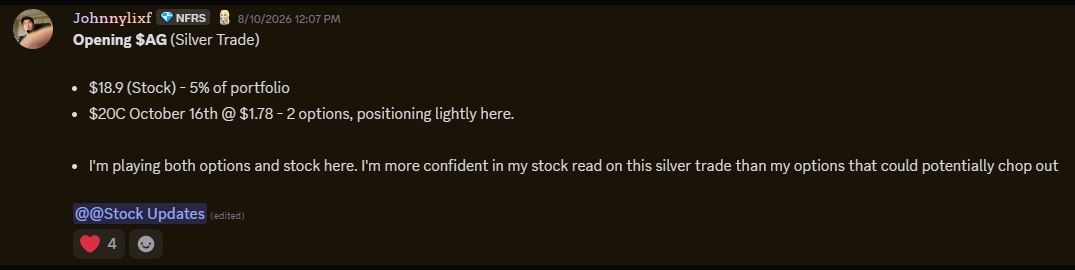
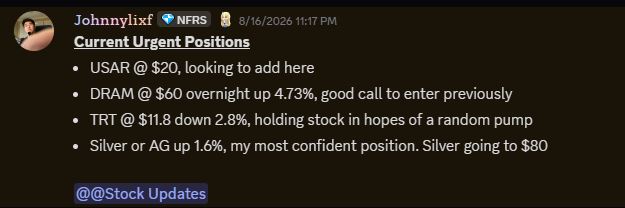
Johnny — Entry alert
Stock entry
“Bought $OUST $40.7 (5% Portfolio) - See $OUST for trade”
Ticker, his fill price, and the size as a share of his portfolio. The last part is a link through to that stock's thread in the johnnys-portfolio forum channel, where the full analysis lives.
Options entry
“Bought $FPS $50C Nov 20th @ 5.65 or $565 per contract. (Look to start your positions here) Stock Price $41.48”
The options format: strike, expiry, and the price quoted both per share and per contract, plus where the stock was trading at the time so you can judge whether the entry is still valid.
Partial exit
“Sold $OUST $43 (50%) of position here. 7% gains!”
Exits usually come in fractions, with the portion and the result stated. Losses are posted in exactly the same format, with the percentage attached and the reasoning alongside it.
( 04 — BEFORE YOU FOLLOW )
Notes and warnings
- The alert is a pointer, not the whole trade. His analysis for each stock sits in a dedicated thread in the johnnys-portfolio forum channel, and the alert links to it.
- Sizing is given as a percentage of his portfolio. Scale that to your own account instead of copying the raw position.
- The long-term book runs without stop-losses by design. If you need a defined risk exit on every position you hold, follow only his trades and leave the investing book alone.
- The two books have completely different time horizons. Check which one an alert belongs to before sizing it.
( 05 — TERMINOLOGY )
Terminology
| Short form | Meaning | How to read it |
|---|---|---|
| See $TICKER | Link to the write-up | Opens that stock's thread in the johnnys-portfolio forum channel, where the full analysis lives. |
| % Portfolio | Position size | How much of his portfolio the position is worth, e.g. 5% Portfolio. |
| Support | Support level | A price level he buys into for long-term positions. |
| Breakout | Breakout | Price clearing resistance, which is his entry trigger for trades. |
| Thesis | Investment thesis | The researched reason for owning something. Its death is the sell signal. |
| Fib | Fibonacci level | A retracement level he sometimes cites when timing an entry. |
| LEAPS | Long-dated options | Contracts expiring a year or more out, which he may keep after selling the stock. |
Follow Johnny live
Alerts, analysis, and the full reasoning behind every entry, all inside the Nefarious Discord.
The channel opens only if you are already in the server.
( 06 — SIMILAR TRADERS )
If you follow Johnny, look at these
Closest matches on asset, style and risk level.



These alerts are trade ideas, not signals. Trading involves risk, including the possible loss of capital. This page is educational and is not financial advice. Make your own decisions and use risk management.