
The first quad witching
in six years.
Crypto perp DEXs, TradFi’s next chapter,
and how to invest.
Quad witching is back after six years as single-stock futures return. Crypto perpetuals and tokenized real-world assets are raising expectations for longer hours, lower costs and easier access. Here’s how I’m investing in that shift.

20 minutes with Olivia · Every graphic explained
Quad witching is the event.
Investing in the market being built is the opportunity.
Why is there quad witching again?
Single-stock futures are back. Their July 2026 relaunch restores the fourth leg of quad witching for September 18: stock options, stock-index options, stock-index futures and single-stock futures expiring on the same quarterly date.
When OneChicago ended trading in September 2020, the U.S. market lost that fourth category. Six years later, the return of single-stock futures brings it back into the quarterly expiration cycle.
My thesis: crypto perpetuals and tokenized RWAs are pushing TradFi to innovate. Markets that trade around the clock, offer flexible sizing and compete on cost are setting a new standard. The SSF relaunch belongs in that broader story of markets opening up.
From stock certificates to always-open markets.
Each step expands what we can own, hedge and trade. Crypto is accelerating the move toward continuous markets.
The opening bell is no longer the limit.
Crypto perps and tokenized RWAs open these markets to a much wider pool of traders. You can choose a small dollar exposure instead of buying a full futures contract, trade long or short, and access markets beyond the stock-market session. Position sizes still follow each venue’s minimums, and access depends on where you live.
Perpetual futures, the return of single-stock futures and the move toward 24/7 trading give investors more ways to react to news when it happens. My thesis is that more continuous trading can reduce the pressure that builds while a market is closed.
Instead of waiting for the opening bell, traders can adjust exposure as information arrives. That can reduce reopening gap risk in markets that trade continuously. Single-stock futures expand the hedging toolkit but still have session breaks; cash stocks can still gap at their open. Lower overall volatility would also depend on deeper liquidity—longer hours alone do not ensure it.
The sizing difference is substantial. One NQ E-mini contract moves $20 for every index point; NinjaTrader currently lists $46,473 in initial margin to carry it between sessions. That is collateral, not an overnight fee. Micro NQ is one-tenth the contract size. By comparison, Hyperliquid documents a $10 minimum order value, with sizing increments and margin based on the market. Smaller positions make access more practical without requiring a full-sized futures account.
About half the carrying cost of LEAPS.
An options buyer pays for time and an asymmetric payoff. As expiry approaches, that time value erodes; sellers benefit from the decay if price and volatility do not move against them. Selling does not cause the decay—the shrinking time to expiry does. LEAPS give the trade more time, but still carry that cost.
A perpetual removes the expiry clock and its theta decay. The costs become execution fees and variable funding. At Hyperliquid’s base taker rate, entering and exiting a $10,000 BTC position costs $9 in trading fees. Its BTC funding averaged 5.94% annualized over the year through September 17, 2026.
For the comparison, BTC stays flat and the modeled call starts with two years to expiry, a strike at the current price and 50% fixed volatility. Both positions begin with $10,000 of directional exposure; the perp includes $9 in entry and exit fees. The model uses zero interest rates and excludes option commissions, spreads and ETF expenses.
In this flat-price example, a $10,000 perp costs about $603 over a year at that funding rate, including entry and exit fees. A modeled two-year, at-the-money Bitcoin ETF call with the same initial directional exposure loses about $1,237 to time decay over that year. About half the carrying cost of LEAPS: a 51% reduction in this BTC example. Funding varies over time. The call buys a different payoff and caps the buyer’s loss at the premium; a perp position must maintain margin.
Trading hours, fees and ownership—what actually changes
Robinhood’s 24 Hour Market operates during the trading week. IBKR’s overnight access through Blue Ocean ATS is another bridge toward longer equity sessions. These are distinct from a seven-day perpetual market.
Robinhood’s Classic Stock Tokens are derivative contracts tracking stocks, rather than direct ownership of the shares. Ondo, xStocks and Reality have their own product structures.
Hyperliquid fee schedule · Lighter fee schedule. Trading fees are only one cost: spread, slippage and funding also matter. Perps are not automatically cheaper than unlevered shares or LEAPS over a long holding period.
Exposure without an expiration date.
Tokenizing an asset and trading a perpetual are different ways to get exposure. Both expand what crypto infrastructure can offer.
A perpetual has no scheduled expiry. Funding helps connect its price to the underlying market. For a trader, that means no routine contract roll; for a market builder, it means a reusable structure for new exposures. How funding works ↗
Check hours, liquidity and eligibility.
Choose size and post collateral.
Track funding, margin and exit liquidity.
This market has changed scale.
Perpetual DEXs have grown into a substantial trading market. Real-world assets are opening the next door.
Perp DEX monthly volume rose from $81.74B to $739.48B between January 2024 and January 2026. Alongside that expansion, RWA perpetual volume reached $524.79B in Q1 2026, up from $29.74B a year earlier. That RWA figure combines centralized and decentralized venues: it measures trading activity, not tokenized assets held.
Perp DEX monthly volume
JAN 2024 → JAN 2026DEX share of perp volume
UP FROM 2.0%RWA perp volume, year over year
Q1 2025 → Q1 2026Builders can bring new markets onto existing trading infrastructure. trade.xyz is one example on Hyperliquid. The 10.3× quarterly increase covers HIP-3 RWA markets as a whole.
As of September 18, normalized USD-perpetual trading stands at $169.56B over 24 hours, including $19.67B on decentralized venues. Hyperliquid led the three DEXs in this watchlist at $7.90B, followed by Aster at $2.14B and Lighter at $1.29B. Those are all-market perp volumes; the RWA growth comparison above measures a different, narrower category.
My picked plays.
Hyperliquid first. Then the venues, ecosystems and tokenization businesses I’m watching. Today’s snapshot: September 18, 2026.
These are my picks for the shift toward more open markets: HYPE, ASTER and LIT for perpetual trading; BNB, MNT, OKB and BGB for their ecosystems; ONDO for tokenization; and HOOD for brokerage distribution. I’m looking for adoption that translates into durable token economics or business earnings.
For tokens, use supported onchain spot markets. For supported exchange pairs, join Bitunix with my referral link ↗. Registration is available without KYC.
Nine names. One market shift.
| ASSET | EXPOSURE | MARKET CAP | 2026 CHANGE | CHART |
|---|---|---|---|---|
| Perpetual venue | $19.47B | +245.1% | ||
| Perpetual venue | $2.02B | +8.5% | ||
| Perpetual venue | $1.24B | — | ||
| Exchange ecosystem | $100.04B | -12.6% | ||
| Mantle ecosystem | $1.92B | -39.3% | ||
| Exchange ecosystem | $2.40B | +4.2% | ||
| Exchange ecosystem | $1.36B | -44.1% | ||
| Tokenization | $1.86B | +7.6% | ||
| Brokerage equity | $98.73B | -2.9% |
Five years of a growing investment universe.
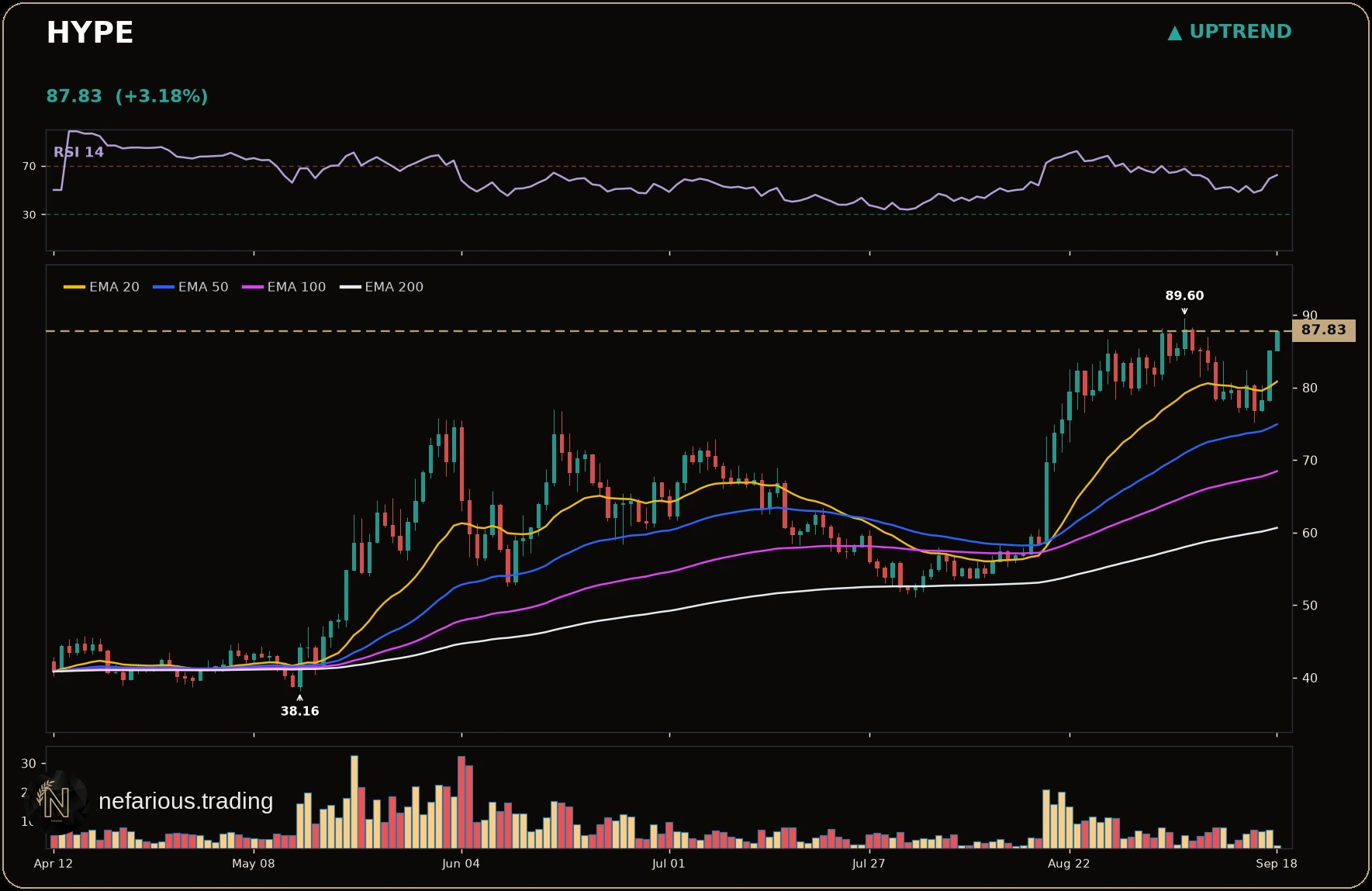
All nine picks show bullish short- and medium-term trend structure. Each trades above its 20-, 50- and 100-day EMA in this snapshot.
The charts below show the gains across the last five years, or the available history for newer tokens. Each uses its own dollar scale, with starting and latest prices shown beside the percentage gain. These are price returns; the trading-volume charts above show how much the underlying industry has grown.
Hyperliquid HYPE
My first focus. Hyperliquid combines a deep perpetual market with infrastructure that lets builders launch new markets. HIP-3 expands what can trade on the same rails. Watch recurring volume, fees and how those economics reach HYPE.
The opportunity is to own the infrastructure making markets more open, more flexible and easier to reach.ENICK / NEFARIOUS